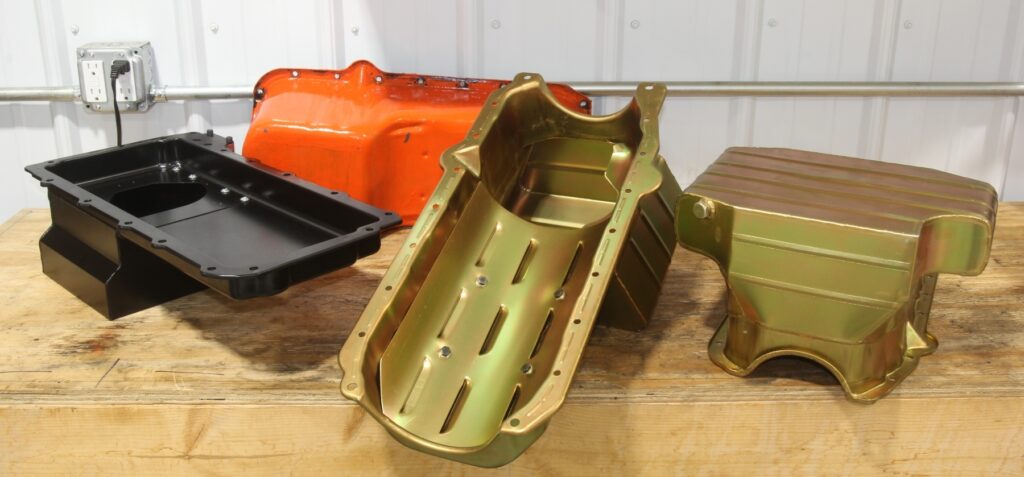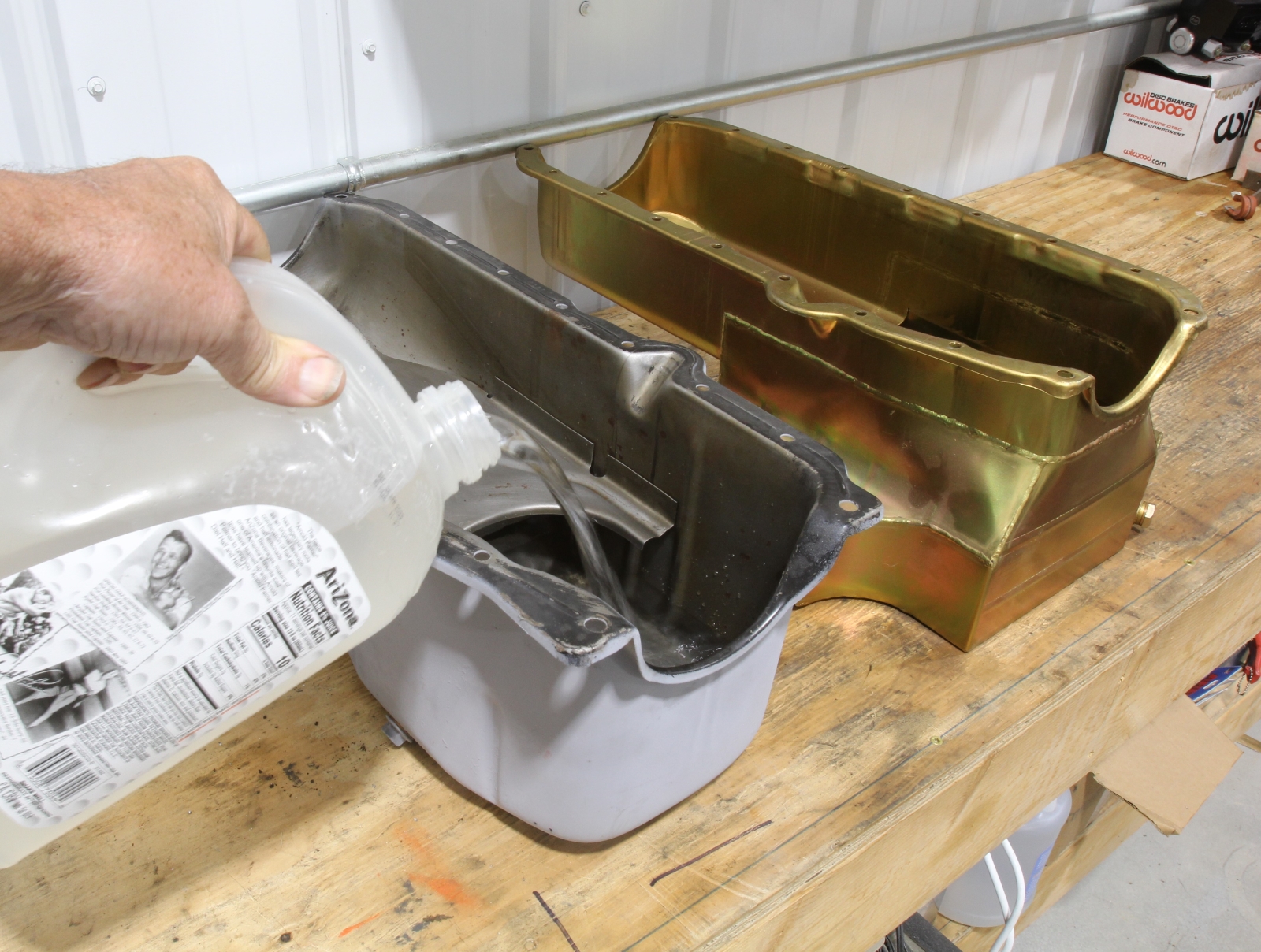
There’s an old saying about not being smart enough to pour water out of a boot. But in this case, we’re smart enough to pour water into an oil pan, and we have a good reason for doing so. We are going to use the oil level in a stock oil pan to find a workable oil level in an aftermarket oil pan. We learned this trick from our friend and engine machinist Ron Flood, who runs Cedar Machine in Minnesota.
Most high-capacity aftermarket oil pans use a combination of a deeper sump and kickouts that widen the sump to increase capacity. For example, a pan could be rated for seven or even eight quarts. While you can run this amount of oil, in many cases you can run less oil in the pan to keep it away from the crankshaft. That helps reduce windage without sacrificing engine reliability.
Conversely, adding more oil as insurance against a loss of oil pressure can cause problems and ironically, a drop in pressure. Many years ago, Westech Performance Group’s dyno guru Steve Brule’ and I performed a test on a big block Chevy where we overfilled the engine with two extra quarts of oil.
The engine lost a slight amount of horsepower, but far more interesting was the drop in oil pressure above 5,000 RPM. At lower engine speeds, oil pressure was stable and increasing. But at 5,000 RPM, oil pressure abruptly nosed over around 50 PSI. This was due to oil aeration—air trapped in the extra oil as the rotating crankshaft churned it into foam. When the oil entered the oil pump, the air compressed and reduced overall oil pressure. The point of this is that adding even one quart over capacity “just to be safe” could instead reduce oil pressure at higher engine speeds, which is of no benefit.
Oil Level Test: Small Block Chevy
We will be experimenting with small block Chevy and GM LS oil pans, but these same techniques can be employed on any engine using a high-capacity pan. Ron Flood suggested sitting the pans level on the work bench to conduct the tests.
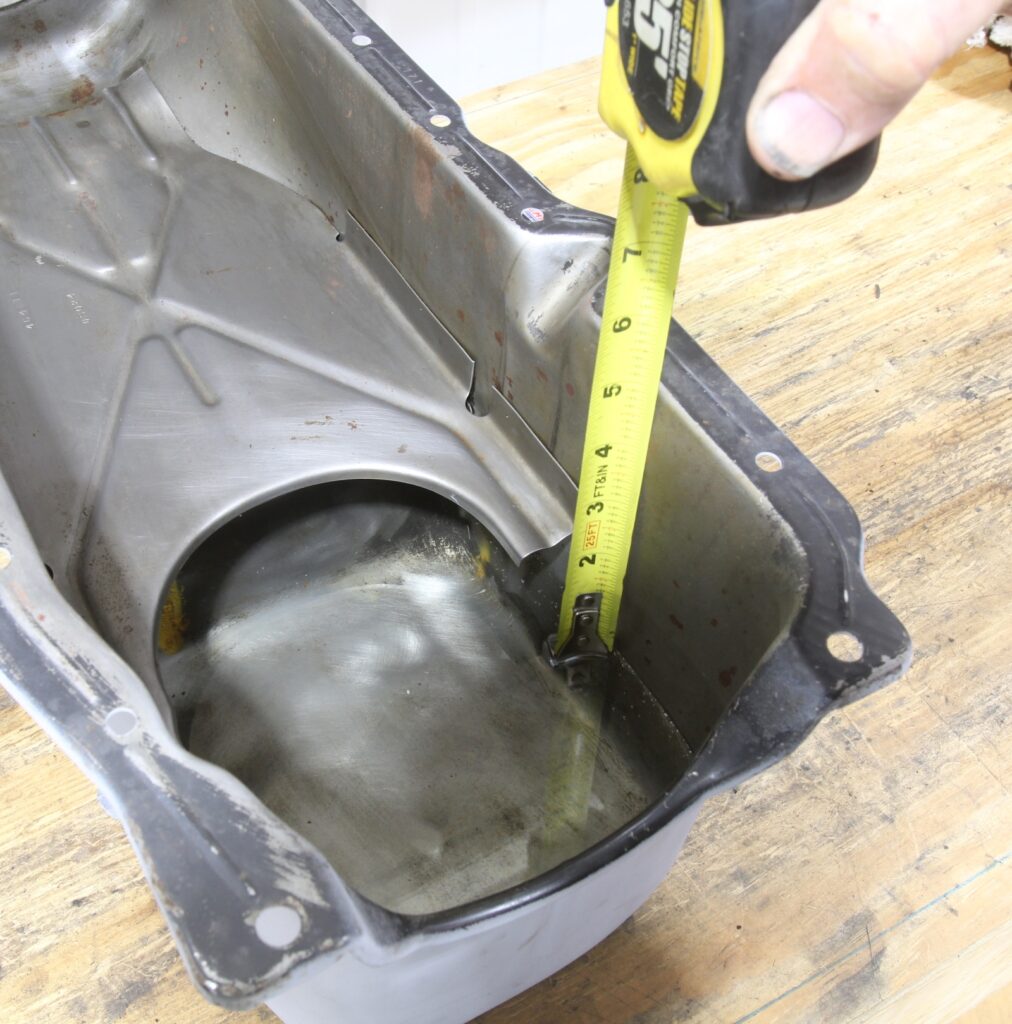
We started with the small Chevy pans. The factory pans have a five-quart capacity—four quarts in the pan and roughly one quart in the oil filter. We poured four quarts of water into a factory pan and measured the height of the water relative to the pan rail. The water level was 3 7/8-inches below the pan rail.
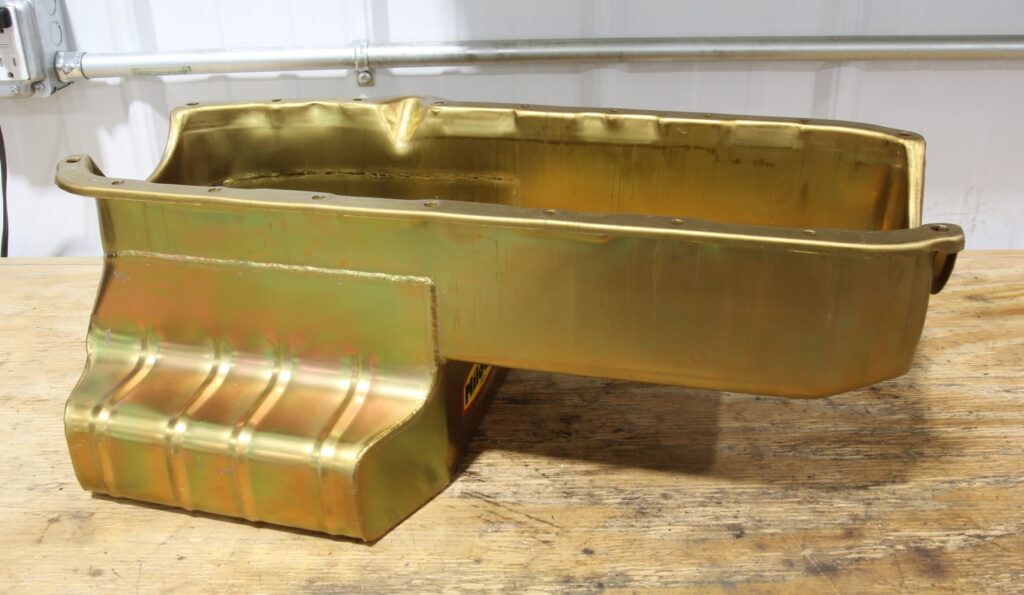
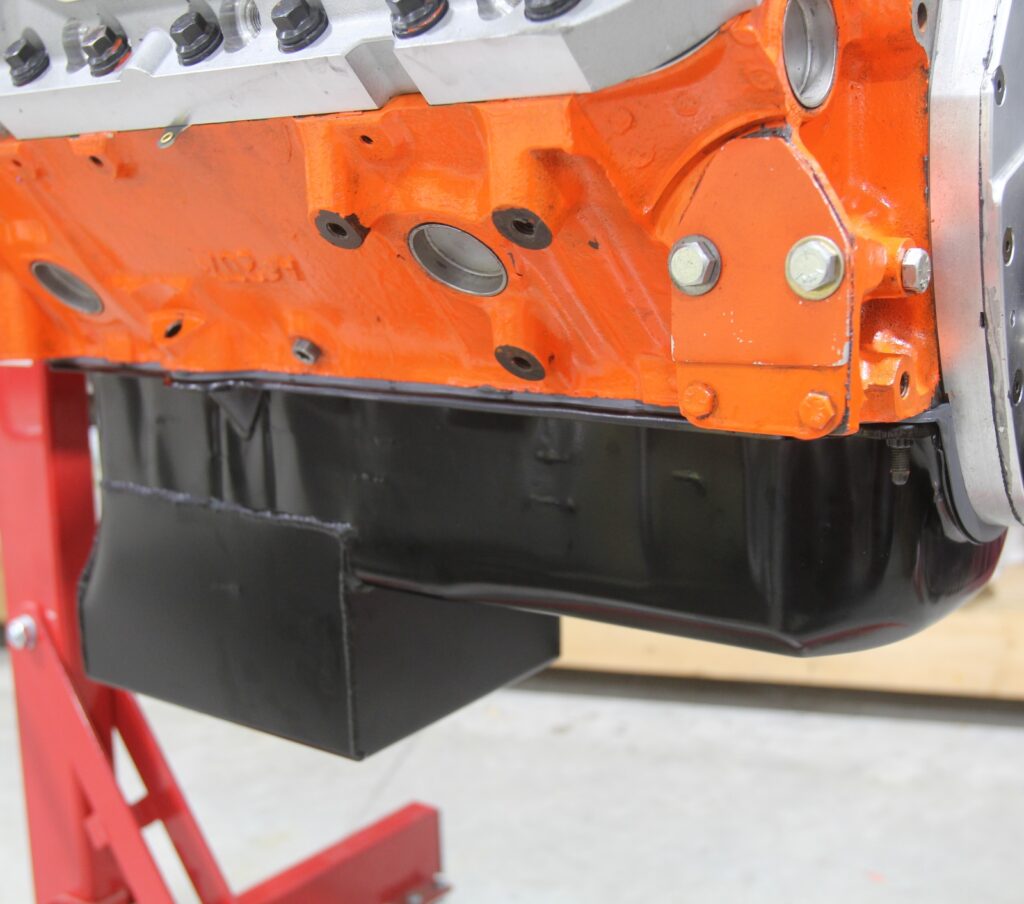
We performed the same test with an eight-inch deep Milodon kickout pan we had left over from a previous engine build. That pan is rated at seven quarts of capacity. We poured four quarts of water into the pan and found the level was significantly lower than it was in the stock pan.
When we increased the amount of water to 5 1/2 quarts, the level increased to five inches below the pan rail. Even with the additional 1 1/2 quarts, the water level was farther away from the spinning crankshaft than it was in a stock oil pan. This is important because the closer the oil level is to the crankshaft, the more potential to lose power due to windage issues where the crank and connecting rods are forced to spin through a heavy cloud of oil vapor.
Of course, there will be less oil in the sump with the engine running. Conventional wisdom holds there is roughly two quarts of oil in the upper portion of the engine, which leaves two quarts or so in a factory pan. Kickout pans with their additional capacity contain more oil in the sump, but sits farther from the spinning crank compared to a stock pan.
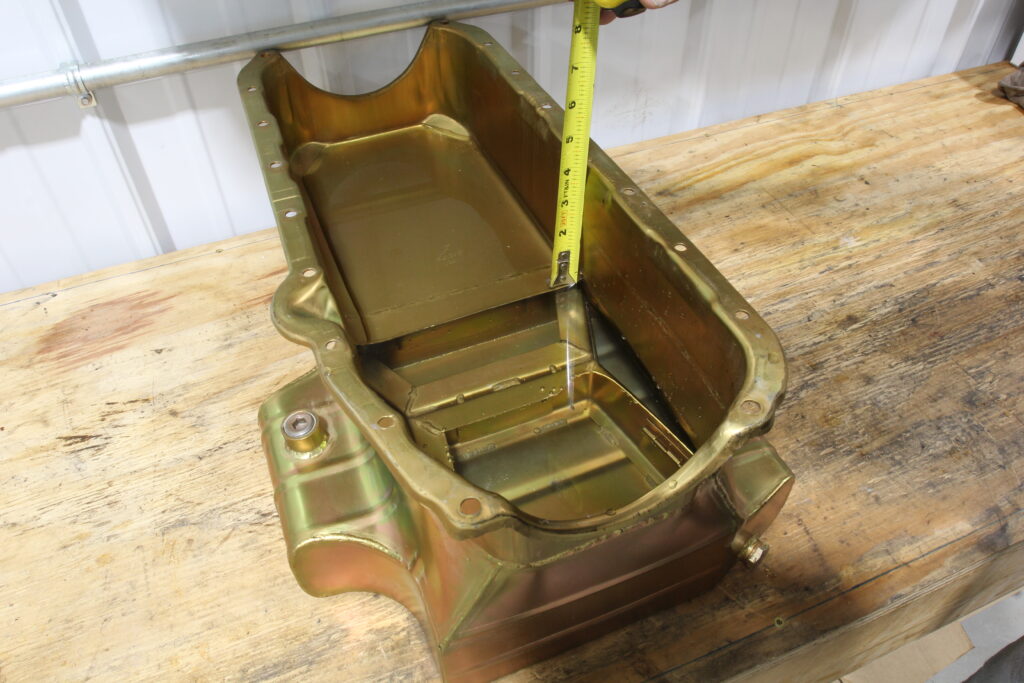
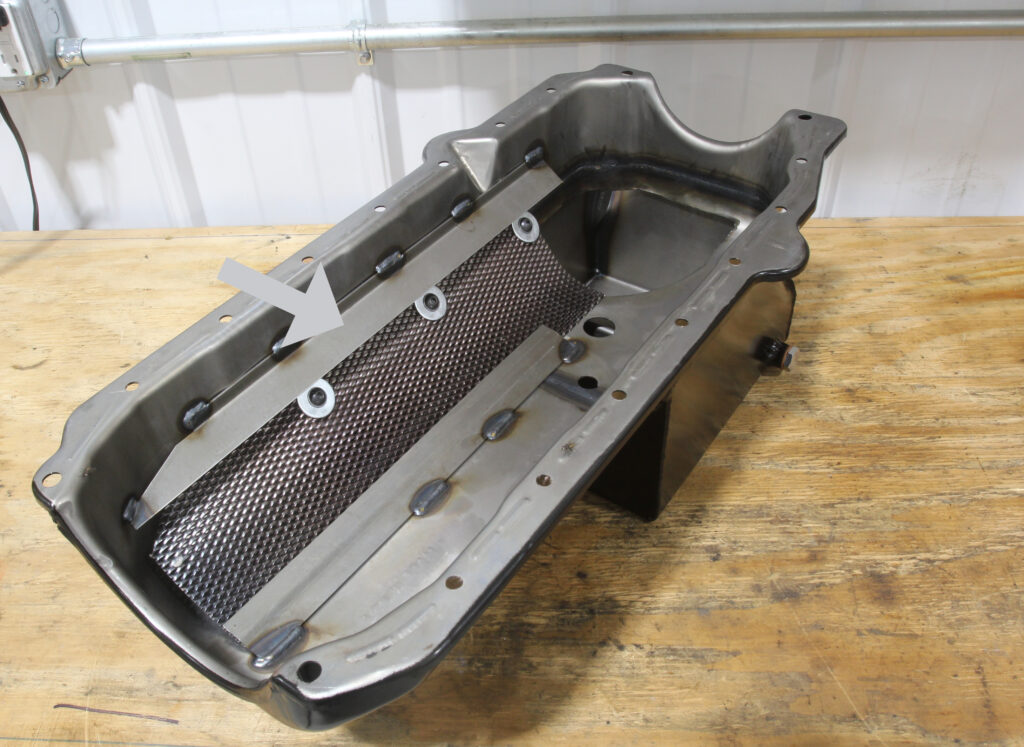
We decided to do a similar test with a Summit Racing pan for a small block Chevy. It’s an eight-inch-deep pan with a built-in windage tray. With four quarts of water in the sump, the level was five inches below the oil pan rail, more than one inch farther from the spinning crankshaft than in a stock pan.
It’s worth noting that the Summit Racing oil pan is rated at six quarts of capacity. While you could certainly add a fifth quart to the pan (assuming the sixth would be for the filter), our test showed that four quarts would be more than enough oil to feed the pump while keeping that oil away from the crankshaft. That alone would likely result in a small increase in horsepower.
This is further enhanced by the scraper and diamond windage tray built into the Summit Racing oil pan. A long time ago, noted race engine builder Kenny Duttweiler told us that his testing revealed that the most efficient way to reduce windage was using a simple crank scraper on the passenger side of the pan to strip oil off the rotating crankshaft.
Again, these measurements are based on a non-running engine. With the engine running at 5,000 RPM, the oil level in the pan would be significantly lower. A typical small block Chevy with a stock-capacity oil pan and a high-volume pump will not suck the pan dry, even at 6,500 RPM. A deep sump pan with its greater capacity will do a better job of maintaining oil pressure even running only four quarts of oil.
Oil Level Test: GM LS
We performed the same test with GM LS oil pans. We started with a stock Gen IV truck-style oil pan filled with four quarts of water. The fluid level was roughly even with the horizontal tray in the pan, about 3 3/8 inches down from the oil pan rail. FYI, this pan is extremely deep and should not be used for LS engine swap conversions in older muscle cars because it drastically reduces ground clearance.
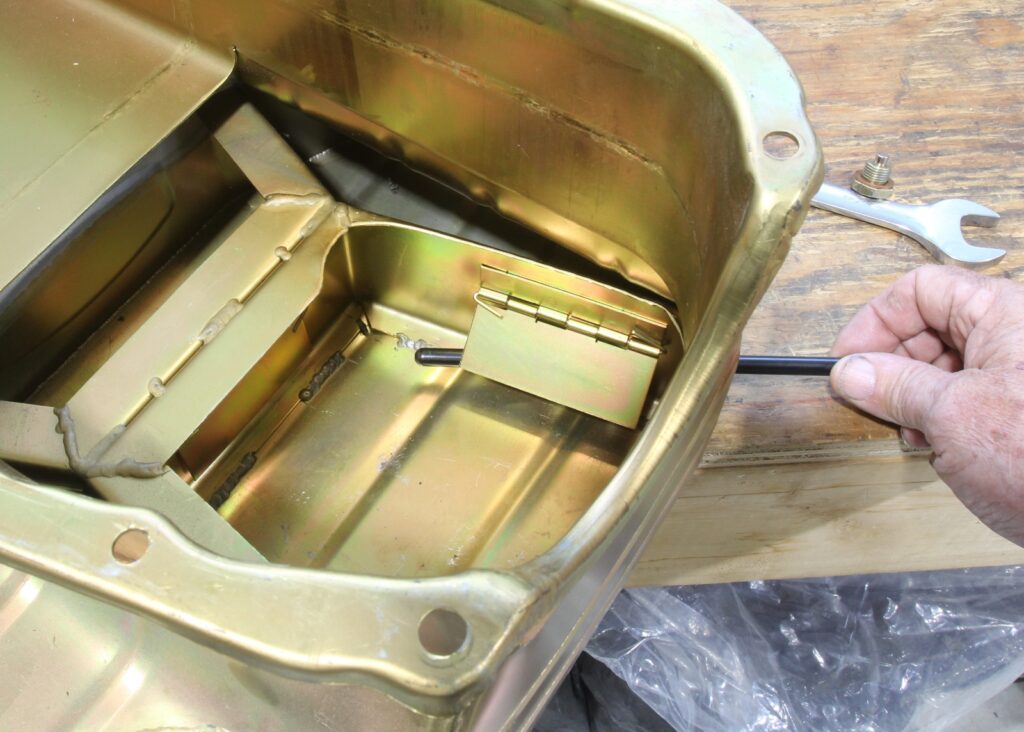
We then performed the same test using a Summit trap door oil pan with a six-inch-deep sump. Filling the pan with four quarts of water put the fluid level three inches below the pan rail and a solid 1 3/4-inch below the built-in trap door tray.
Checking Oil Level with the Engine in the Car
If your engine is in the car, you can still evaluate the oil level by adding the amount you think will work and do a test run in the car. You want to run the engine through peak RPM while a friend monitors oil pressure. If oil pressure drops off above 5,000 RPM, add a half-quart of oil to the engine and test it again. If the pressure drops off again, drain a quart of oil and test it again. If the oil pressure remains steady from above 5,000 RPM to peak RPM, you’ve achieved a working oil level.
Acceleration’s Impact on Oil Level
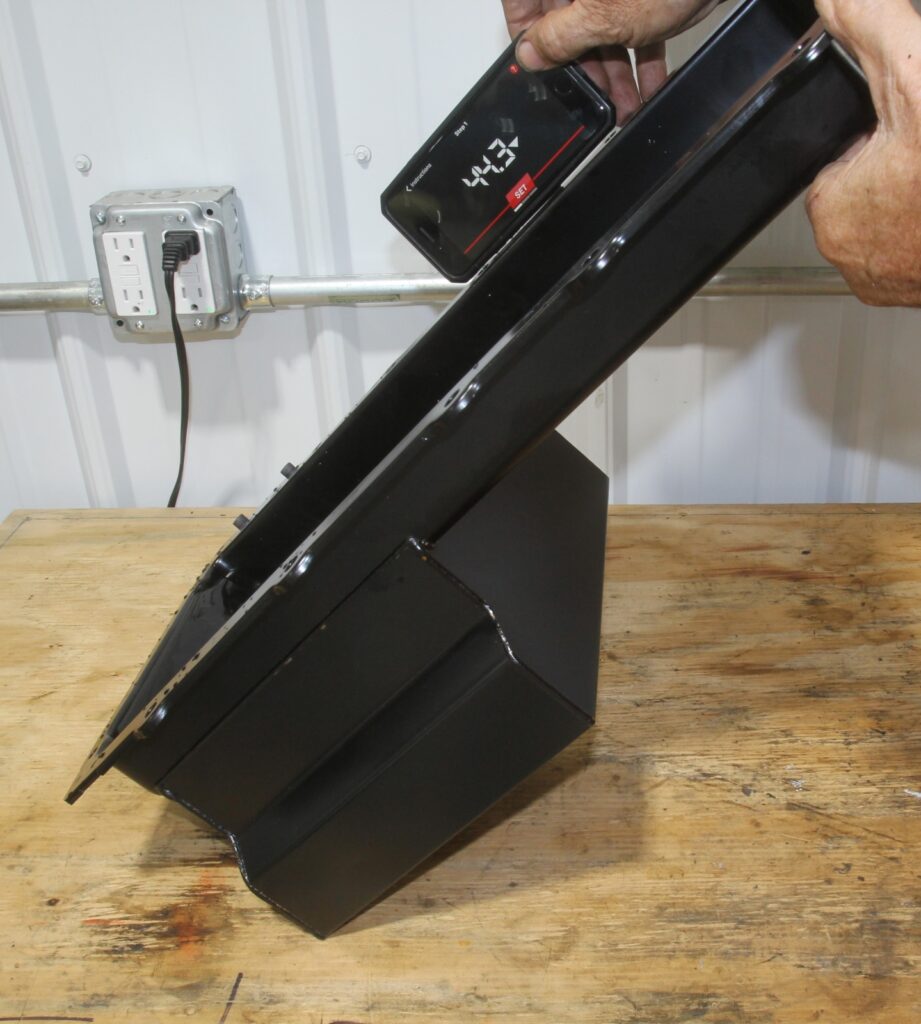
Up until this point, we have addressed oil level in a static situation and with a running engine. But what happens when the oil in the pan is subjected to 1g of acceleration? From the oil’s standpoint, 1g, or the force of gravity with forward acceleration (like at the starting line of the drag strip) has the same effect as tilting a stock oil pan at a 45-degree angle. Hard acceleration can surge the oil in a stock oil pan enough to uncover the oil pump pickup. This is why deep sump pans work so well for drag race engines because the deeper sump and trap doors retain oil around the pickup.
This situation holds true with engines running in autocross or road racing where the car is capable of generating 1g or higher lateral acceleration. This sends the oil sideways in the sump, which is why the kickout style pans work so well to retain sufficient oil around the pickup.
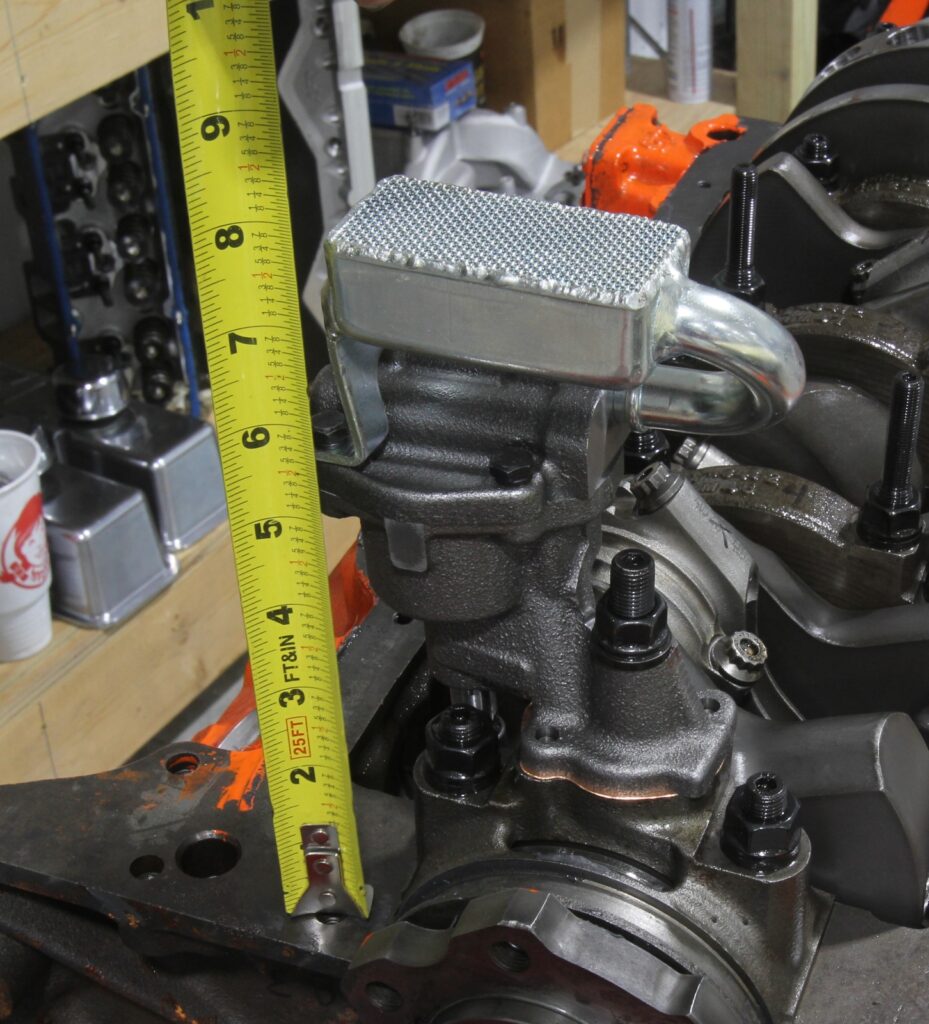
Placing the oil pump pickup close to the floor of a deep-sump pan is important too. With both high-g lateral and fore-aft movement of the oil, the pickup will still be sufficiently submerged to maintain oil pressure. A stock oil pan with a shallow sump has zero chance of maintaining oil pressure under these conditions.
Hopefully, this story gives you an idea of how to determine the right oil capacity when using an aftermarket oil pan. Our testing revealed that you can potentially run less oil than the pan’s maximum stated capacity without experiencing lubrication problems. Even with a deep sump pan, in most cases you can run at stock oil capacity or one quart over and maintain proper protection for your engine. The best way to find the correct oil level for your specific application is conducting your own testing.
Parts List
Summit Racing™ Pro Pack Oil Pan and Pump Kit for small Chevy SUM-PANKIT5
Milodon Pro Touring Oil Pan for small Chevy, 7-quart/8″deep sump MIL-31505
Summit Racing™ LS Oil Pan for Camaro and Nova, 7-quart/6″deep sump SUM-G3612B